Public maturity
TRL 6 complete; TRL 7 development and validation underway.

Photonic RF Sensing
Optii's approach is designed to remove powered electronic detection components from the forward sensing end, separating the sensing point from the analysis side through fibre.
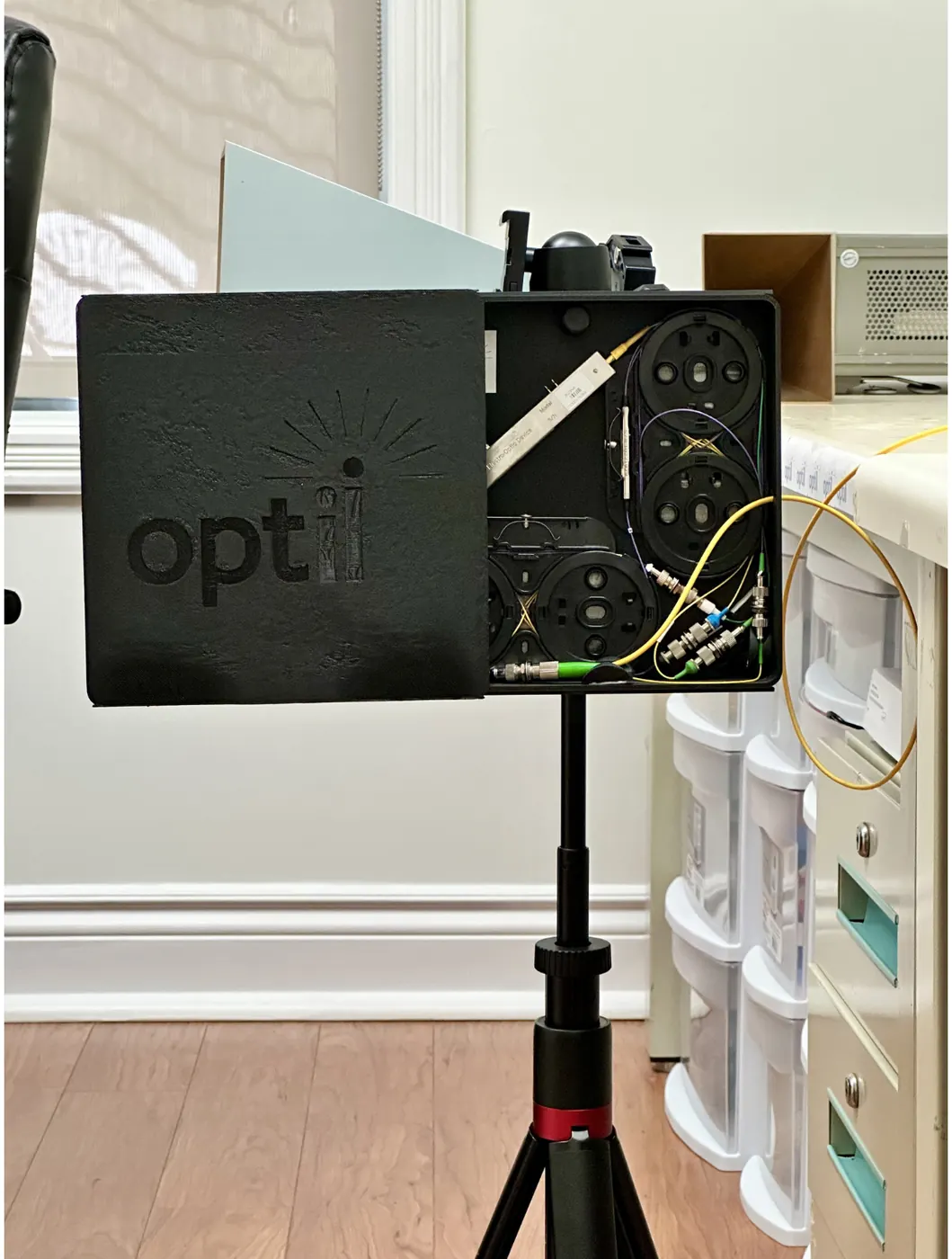
A concise, visual, and non-proprietary explanation of the sensing concept.
TRL 6 complete; TRL 7 development and validation underway.
Operationally relevant demonstrations, repeatability and maturation activities are now the focus.
Planned and being coordinated through strategic pathways.
TRL 6 complete; TRL 7 development and validation underway.
Planned expansion beyond the demonstrated X-band (8–12 GHz) engineering focus; not continuous demonstrated coverage.
Laboratory work has demonstrated a frequency-selective photonic response; no public linewidth measurement is stated.
Approximately -40 dBm under tested laboratory conditions
Up to 100 km fibre-link separation potential, subject to system configuration and validation. This is not a free-space RF detection range.
No local battery or powered detection electronics at the forward sensing head; central processing equipment requires power
Discuss technical fit, demonstrations, integration opportunities, or partner evaluation pathways with Optii.