Current validation
TRL 6 completed; TRL 7 development underway.

Technology
Optii uses fibre-optic sensing and photonic signal response to support detection and interpretation of RF activity without relying on traditional powered electronic detection components at the forward sensing point.
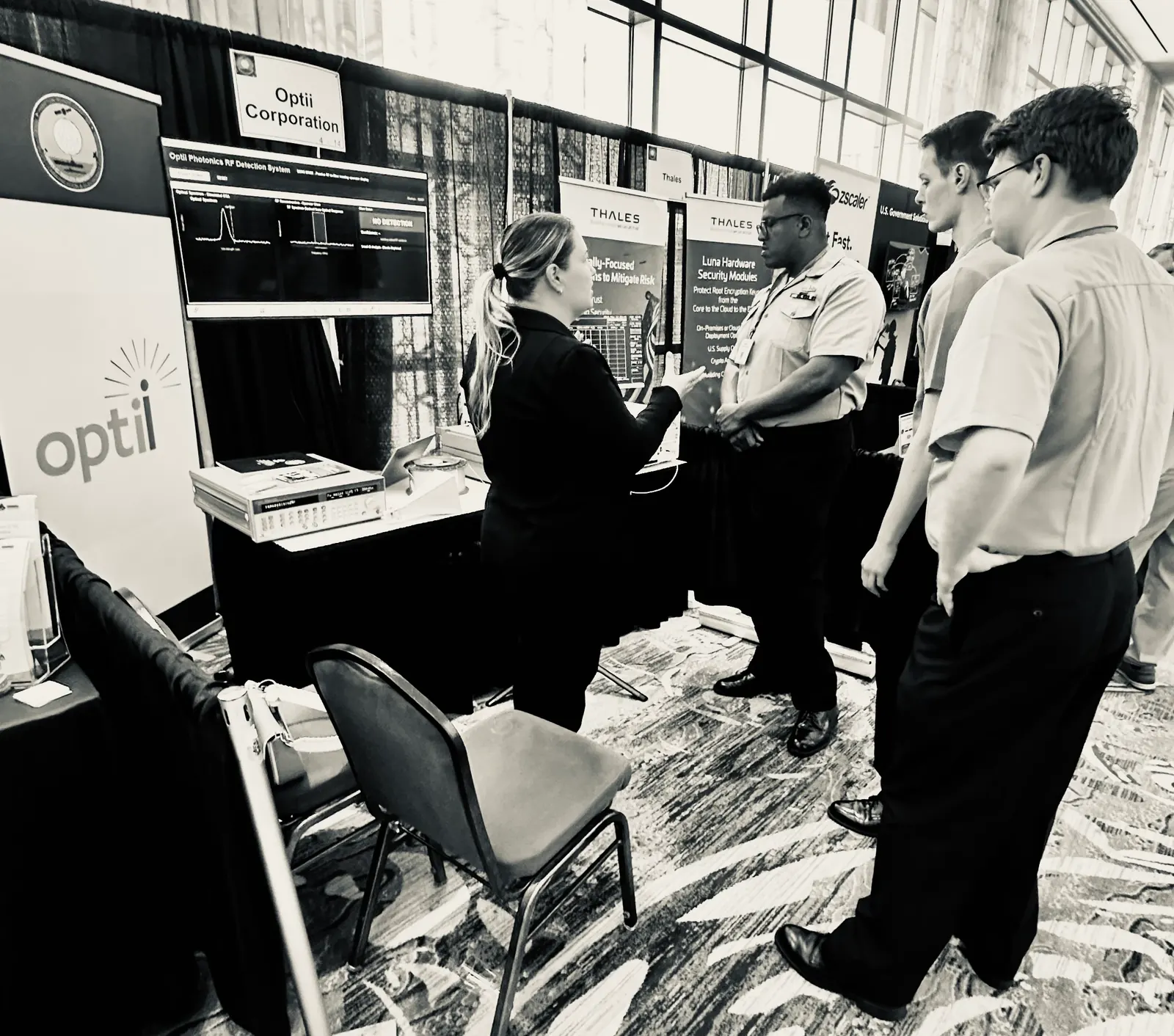
Optii combines passive photonic sensing, software-assisted interpretation, and a patent-backed photonics foundation.
Passive sensing architecture designed for contested and mission-critical environments.
Tools for detection, classification, monitoring, alerting, and fibre health awareness.
RF sensing patent-pending work supported by foundational photonics IP.
TRL 6 completed; TRL 7 development underway.
Planned expansion toward broad multi-band RF sensing coverage.
Narrow linewidth response supporting frequency isolation.
RF detection demonstrated at signal levels down to approximately -40 dBm under tested laboratory conditions.
Fibre-enabled sensing architecture concept, subject to configuration and validation.
Designed without local power or battery at the forward sensing end.
Review the sensing process, integration fit, technical maturity, and next-step evaluation pathways with the Optii team.